When you decide to sell your business, finding the right business sale broker is one of the most important decisions you will make. The right broker can help you navigate the complexities of selling your business, from valuation to finalizing the deal. In this guide, we’ll walk you through the key factors to consider when choosing a business sale broker, and why partnering with an experienced firm like AE Brokers (visit their website.

A business sale broker, also known as a business intermediary or mergers and acquisitions (M&A) advisor, is a professional who facilitates the sale of a business. They help business owners find potential buyers, negotiate the sale terms, and ensure the transaction is completed smoothly and legally. Their role is crucial to securing a fair price for your business and to managing the complexities of the sale process.
Choosing a broker with industry-specific experience is essential. Each industry has its unique challenges, trends, and buyer profiles. A broker with experience in your sector will be better equipped to assess your business’s value, find suitable buyers, and understand the nuances of your business model.
Why AE Brokers?
AE Brokers specialize in various industries and have a deep understanding of what works in different sectors. Their knowledge and expertise ensure they can navigate the complexities of your industry, whether you own a manufacturing business, retail store, or tech startup.

A business sale broker's reputation is critical to ensuring a smooth sale process. Look for a broker with a proven track record of successfully closing business sales. You can request references, read online reviews, and review testimonials from past clients.
Why AE Brokers?
AE Brokers have earned a reputation for delivering results. Their extensive portfolio of completed transactions demonstrates their expertise in helping business owners like you sell their businesses quickly and at the best possible price. Review their testimonials to see why clients trust them with such a critical transition.
Business brokers typically charge a commission, typically 5% to 10% of the final sale price. However, some brokers may also charge upfront fees or additional costs for marketing and other services. It’s crucial to understand the broker’s fee structure and ensure there are no hidden charges.
Why AE Brokers?
AE Brokers offer a transparent pricing structure with no hidden fees. Their commission is straightforward, and they work hard to secure the best possible deal while keeping the process as cost-effective as possible.
A good business sales broker should have a broad network of potential buyers, including individual investors, companies seeking acquisitions, and private equity firms. They should also have effective marketing strategies in place to attract qualified buyers for your business.
Why AE Brokers?
AE Brokers have an extensive network of buyers and investors, both locally and globally. Their marketing strategy is tailored to your business type, ensuring that it reaches the right buyers. Whether they’re using online platforms, industry-specific channels, or leveraging their own contacts, AE Brokers have the tools to market your business to the right audience.
Confidentiality is a top priority when selling a business. You don’t want your employees, customers, or competitors to know that you are looking to sell until the deal is finalized. A professional business sale broker will ensure that your business’s sale remains confidential throughout the process.
Why AE Brokers?
AE Brokers understand the importance of discretion. They take confidentiality seriously and use non-disclosure agreements (NDAs) to protect your business interests. Their process ensures that sensitive information remains private, reducing the risk of disruption to your operations during the sale.
Negotiating the sale of a business can be a delicate and challenging process. A skilled business broker will help you get the best deal by navigating tough negotiations, addressing buyer concerns, and handling any objections that may arise.
Why AE Brokers?
AE Brokers are expert negotiators with years of experience in securing favorable terms for business owners. Their negotiation skills are one of the reasons many businesses are sold faster and at a higher price than they might have achieved otherwise.
Selling a business involves more than just finding a buyer. You’ll need assistance with due diligence, legal documentation, financial disclosures, and closing the deal. Choose a broker who offers comprehensive support throughout the entire process.
Why AE Brokers?
From valuation to closing, AE Brokers offer end-to-end support. Their team of experts, including accountants and lawyers, work together to ensure the sale process is smooth and all legal and financial aspects are handled correctly.
AE Brokers specialize in fast-tracking business sales. Their streamlined process is designed to reduce the time it takes to find a buyer, negotiate terms, and close the deal. This means less stress for you and a quicker transition.

AE Brokers work diligently to maximize the value of your business. Their experience and strategic marketing techniques allow them to present your business in the best possible light to potential buyers.
With access to a broad range of potential buyers, AE Brokers help ensure that your business sale reaches the right audience. Whether it’s a local buyer or an international investor, AE Brokers can find the right match for your business.
If you’re ready to sell your business and want to ensure a smooth, successful transaction, AE Brokers can help. Visit their website at sellmybusinessfast.org to schedule a free consultation and learn how their expert team can assist you in selling your business quickly and at the best price.
Choosing the right business sale broker is a critical step in ensuring the success of your business sale. By focusing on experience, reputation, transparency, and a comprehensive support system, you can find a broker who will streamline and improve profitability. AE Brokers offers a wealth of knowledge and resources to guide you through every stage of selling your business, ensuring that you achieve the best possible outcome. Reach out to them today and take the first step toward selling your business with confidence.
If you’re considering selling a business valued at $1M or more in Chicago, the process is both an opportunity and a challenge. The stakes are high: you want the best possible price, a seamless transaction, and a trustworthy expert who understands the local market. This article explains, step-by-step, what business owners like you actually need to know—so you can make an informed decision and maximize the value of your hard-earned asset.
If you own a substantial business in Chicago, choosing to partner with an experienced business broker can directly impact your financial outcome. Here’s what separates a standout broker from the crowd:
Tip: A great broker acts as both shield and advocate—screening buyers, guiding you through due diligence, and resolving issues before they can derail the deal.
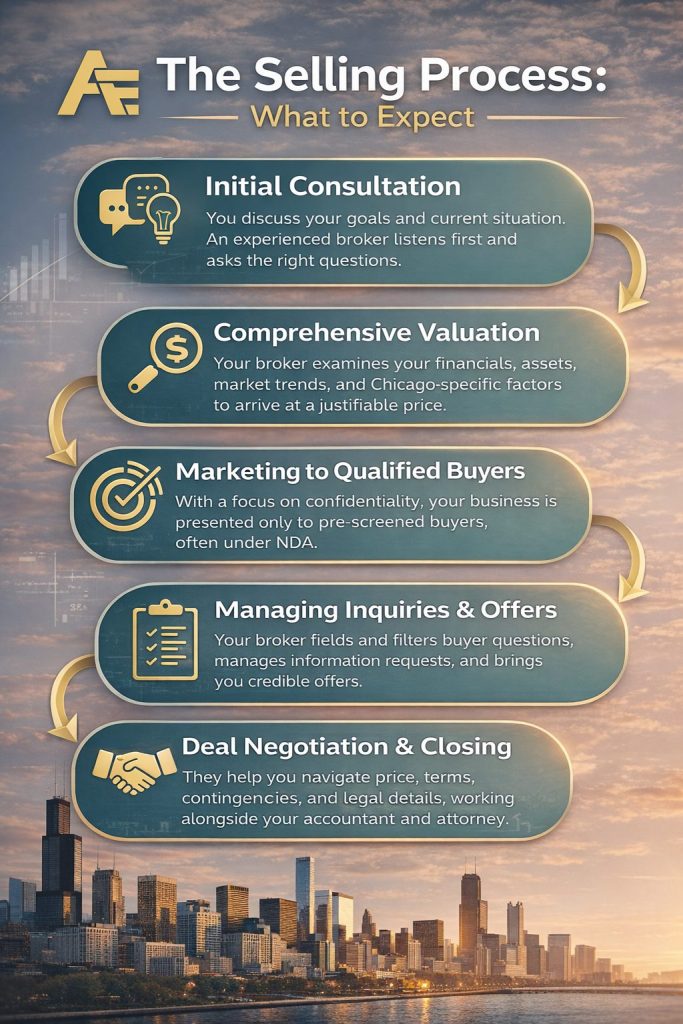
Selling a larger business is not a simple classified posting. It is a carefully managed, multi-step sequence:
Chicago isn’t just another large city. The area’s economic landscape, regulatory environment, and buyer pool are distinct. Here’s why going local is a must:

Look for a broker who demonstrates:
Tip: Don’t be swayed by generic promises. Insist on case studies and testimonials relevant to your business size and industry.
Q: How long does it take to sell a $1M+ business in Chicago?
A: Most sales take 6–12 months, but a skilled broker can accelerate the process by targeting ready buyers and preparing due diligence upfront.
Q: How do I keep the sale confidential?
A: A professional broker uses NDAs and limits exposure, ensuring your employees, vendors, and competitors do not learn of the sale before you’re ready.
Q: What does a broker charge?
A: Expect fees from 8–12% of the closing price, typically contingency-based (you pay only upon closing). Some may offer fixed-fee consultation for valuations.
If your business is thriving and you are considering an exit, find out what it’s truly worth in today’s Chicago market. Knowledge is leverage—whether you choose to move forward now or later.
Get a Free Business Valuation
(Use the contact form in the right-hand sidebar for a confidential, no-obligation analysis.)
Choosing the right business broker in Chicago is not just about the sale; it’s about protecting the legacy of what you’ve built. Set yourself up for success with local, trusted expertise.
What’s your biggest concern about selling right now? Are you ready for your business’s true value?
Let’s start the conversation—your next chapter begins here.
Looking to buy or sell a business in Naples, FL? A.E. Business Brokers, the best Business Brokers in Naples, FL, is here to assist you every step of the way. With our expertise and experience in the local market, we have established ourselves as the go-to resource for all your business brokerage needs in Naples.
Our team of dedicated professionals understands not only the unique challenges and opportunities that come with buying or selling a business but also the intricate dynamics of the vibrant coastal city of Naples, FL.
Whether you are a seasoned entrepreneur looking to expand your portfolio or a first-time buyer looking for the perfect investment opportunity, we have the knowledge and resources to guide you through the process.
From valuation and marketing to negotiations and closing, we will work tirelessly to ensure a seamless and successful transaction. Trust A.E. Business Brokers Naples to help you achieve your business goals in this thriving market.
At A.E Business Brokers Naples, FL, we don't just claim to be the best. We have a proven track record of successfully facilitating business sales in the Naples area. Our team has a deep understanding of the local market dynamics and knows how to navigate the complexities of buying and selling businesses in this region.
Client Testimonials and Case Studies: Don't just take our word for it—hear from our satisfied clients! We have a collection of testimonials that showcase the positive experiences our clients have had working with us. We also provide case studies that highlight specific business sales we have completed, demonstrating our expertise and ability to deliver results.
Industry Awards and Recognitions: Industry leaders have recognized our commitment to excellence. We are proud recipients of various awards and accolades acknowledging our outstanding performance as Business Brokers. These accolades serve as a testament to our professionalism, integrity, and success in helping businesses achieve their goals.
Our team at A.E Business Brokers Naples, FL, is comprised of highly experienced professionals with a wealth of knowledge in business brokerage. Each member brings unique qualifications and expertise to the table, ensuring that our clients receive top-notch service throughout the entire process.
Relevant Qualifications: Our team members hold relevant qualifications, such as certifications in business brokerage and real estate. These credentials demonstrate their expertise and dedication to providing exceptional service to our clients.
Years of Experience: With years of experience in the field, our team understands the intricacies of buying and selling businesses. We have encountered various scenarios and challenges, allowing us to anticipate potential issues and find effective solutions. Our experience translates into a smoother and more successful transaction for our clients.
Ongoing Training and Professional Development: We believe in continuous improvement and staying up-to-date with the latest trends and best practices in business brokerage.
Our team regularly participates in training programs and professional development opportunities to enhance their skills and knowledge. This commitment ensures that we are always equipped with the most current strategies and tools to serve our clients effectively.
At Business Brokers Naples, FL, we understand that each business is unique and requires a tailored approach to achieve a successful sale. We work closely with our clients to develop personalized selling strategies that align with their specific goals and objectives.
Personalized Plans: We thoroughly analyze each business and its market position. Based on this analysis, we create customized plans that outline the steps needed to attract qualified buyers and maximize the business's value.
Market Trends and Buyer Preferences: Our team stays informed about the latest market trends and buyer preferences. By understanding what buyers are looking for in businesses, we can position our clients' businesses to appeal to potential buyers, increasing the likelihood of a successful sale.
Unique Selling Propositions: To stand out in a competitive market, we help our clients identify their unique selling propositions. These are the qualities or features that set their businesses apart from others. By highlighting these unique aspects, we can attract buyers who recognize the value and potential of the business.

At A.E Business Brokers Naples, FL, we have developed a ten-step methodology to ensure a smooth and successful selling process for our clients. This structured approach guarantees thoroughness and maximizes the chances of a favorable outcome.
One key advantage of working with A.E. Business Brokers Naples, FL, is our ability to match sellers with pre-qualified buyers quickly. We leverage advanced technology and our extensive network to identify potential buyers who are actively seeking business acquisitions.
By streamlining communication between buyers and sellers, we expedite the sales process and increase the likelihood of a successful transaction. Our efficient buyer-matching system saves time for both parties involved and ensures that the right buyers are connected with the right businesses.
At A.E Business Brokers Naples, FL, we maintain an extensive database of potential buyers. This database is regularly updated with new leads and is segmented by industry and investment criteria. By categorizing buyers based on their specific preferences, we can target the most relevant audience for each business listing.
Our comprehensive buyer database allows us to efficiently market businesses to a wide range of potential buyers. This process increases the chances of finding the ideal buyer who aligns with the seller's objectives. With our extensive network and thorough knowledge of the local market, we have access to a diverse pool of qualified buyers.
Accurate valuations play a crucial role in the success of selling a business. When it comes to determining a business's value, potential buyers rely heavily on the information provided by the valuation process. A business valuation provides an objective assessment of the company's worth, which helps buyers make informed decisions.
Market conditions also significantly impact a business's value. During periods of economic growth, businesses tend to have higher valuations due to increased demand and competition.
Conversely, during economic downturns, businesses may experience a decrease in value. Understanding these market conditions is essential for both buyers and sellers to navigate the business sale process effectively.
Moreover, valuation plays a vital role in setting realistic expectations for sellers. It provides them with a clear understanding of their business's worth, enabling them to make informed decisions about pricing and negotiation strategies.
With an accurate valuation in hand, sellers can confidently approach potential buyers and engage in productive discussions.
Obtaining a valuation for your business is straightforward and involves several steps. First, you need to gather all the necessary financial and operational information about your business.
This process includes financial statements, tax returns, and other relevant documents. Once you have collected this information, you can submit it to a business broker who specializes in valuations.
The valuation process typically takes two to four weeks, depending on the complexity of the business and the availability of data. During this time, the appraiser analyzes various factors, such as industry trends, financial performance, and market conditions, to determine the value of your business.
Transparency is key throughout the valuation stages. The appraiser should provide regular updates on the valuation's progress and be available to answer any questions or concerns you may have. By maintaining open communication and transparency, you can ensure a smooth and reliable valuation process.
Requesting a valuation is simple. Potential sellers can use multiple methods to contact A.E. business brokers. You can also contact them directly via phone or email to discuss your needs and request a valuation.
Alternatively, many brokers also offer online request forms on their websites, making it easy for sellers to initiate the valuation process.
To request a valuation, provide your contact information and some basic details about your business, such as its industry, location, and annual revenue. The broker will then get in touch with you to gather additional information and guide you through the valuation process.

At our business brokerage firm, we understand the importance of client satisfaction. That's why we offer a no-sale, no-fee promise to our clients. This means that you only pay us if we successfully sell your business.
We believe in the value of our services and are committed to delivering results. Our promise sets us apart from competitors who may charge fees regardless of whether or not they are able to sell your business.
Confidentiality is crucial when selling your business. We prioritize the protection of your sensitive business information throughout the entire selling process. Our team implements rigorous measures to ensure that all transactions are conducted with the utmost confidentiality.
We have strict policies to safeguard your data and communicate these policies to all parties involved. When working with us, you can trust that your information is in safe hands.
We take pride in our track record of helping clients achieve their goals through successful business sales. Our portfolio includes a wide range of client success stories across various industries. These stories highlight the role our brokerage plays in facilitating profitable business opportunities.
Whether it's a small office or a large corporation, we have helped businesses of all sizes find the right buyers and close successful deals. When you choose our services, you can expect personalized attention, expert guidance, and a proven track record of client success.
We highlighted our unique selling process, which sets us apart from other brokers in the area. We also emphasized the importance of a free business valuation and how it can help you make informed decisions.
Throughout the article, we have showcased our expertise and demonstrated why we are the right choice for your business needs.
[Conclusion] In conclusion, if you are looking to buy or sell a business in Naples, FL, our team of experienced business brokers is here to assist you every step of the way. With our unique selling process and commitment to providing a free business valuation, we are dedicated to ensuring your success. Don't hesitate to reach out to us today and let us help you achieve your business goals.
Business brokers in Naples, FL, can assist you in buying or selling a business by providing expert guidance, conducting market research, facilitating negotiations, and ensuring a smooth transaction process.
Their local knowledge and network can significantly increase your chances of finding the right buyer or seller.
Our selling process stands out due to its personalized approach. We tailor our strategies to meet the specific needs of each client, utilizing comprehensive marketing techniques, thorough business valuation, and targeted buyer outreach. This process ensures maximum exposure for your business and increases the likelihood of a successful sale.
Absolutely! We provide complimentary business valuations to help you understand your business's worth in today's market. Our experienced team will analyze various factors, such as financial performance, industry trends, and comparable sales data, to provide an accurate assessment of your business's value.
By choosing our services, you gain access to a team of experienced professionals who specialize in business brokerage. We have an extensive network of potential buyers and sellers, enabling us to connect you with the right opportunities.
Our expertise ensures a streamlined process, saving you time and effort and maximizing the value of your transaction.
You can reach out to our Naples business brokers by calling our office at [phone number] or sending us an email. We are available to answer any questions you may have and provide further information on how we can assist you in achieving your business goals.
Did you know that some business brokers charge an 'average business broker commission' of 10% upfront on the sale price of a business? That's right, a significant chunk of your hard-earned profits goes straight into their pockets.
But what if there was a better way to sell your business without paying exorbitant or upfront fees? Whether you're a small business owner looking to sell or an entrepreneur searching for a profitable venture, this information will revolutionize the way you approach buying or selling a business.

When considering a business broker, it's important to note that practices around valuation fees vary. Some brokers may charge a fee for providing a professional valuation, especially if the valuation is needed for reasons other than selling, such as settling an ownership dispute.
However, many brokers offer flexibility. They may waive the valuation fee if you decide to proceed with them as your business broker, potentially saving you money. Furthermore, some brokers provide free valuations, making it easier to explore your options without upfront costs.
By understanding these different approaches, you can make a more informed decision that aligns with your business needs and goals.
Business brokers play a crucial role in facilitating business sales. They act as intermediaries between buyers and sellers, helping to connect the right parties and navigate complex transactions.
These professionals are well-versed in the intricacies of the buying and selling process, providing valuable expertise to both sides.
One of the primary functions of business brokers is to help sellers find qualified buyers for their businesses. They have access to a wide network of potential buyers and can effectively market the business to attract interested parties.
By leveraging their industry knowledge and connections, brokers can identify suitable buyers who are genuinely interested in acquiring a business.
Working with a business broker offers strategic advantages for buyers. Brokers have an in-depth understanding of the market and can provide valuable insights into different industries and opportunities.
They can help buyers identify businesses that align with their goals and objectives, saving them time and effort in the search process.
Business brokers typically operate on a commission-based structure. This process means that they earn a percentage of the final sale price when a transaction successfully closes.
The average business broker commission rate can vary depending on factors such as the size of the business and the complexity of the deal.
Some brokers offer additional services, such as consulting or advisory services, in addition to commissions. These services may include business valuations, financial analysis, and guidance throughout the buying or selling process.
By diversifying their revenue streams, brokers can provide comprehensive support to their clients while also generating additional income.
Performance-based earnings are also important for brokers. Their reputation and success depend on their ability to close deals efficiently and effectively.
By delivering results and satisfying their clients, brokers can build a strong track record and attract more business in the future.
The fees charged by business brokers can vary depending on several factors. Small business broker fees typically range from 8% to 12% of the final sale price. However, for larger businesses or middle market transactions, the fees may be negotiable and can range from 5% to 10%.
In addition to these overall small business broker fees, it's important to consider upfront costs. Business brokers who require an initial payment usually charge between $500 and more than $40,000. This amount can depend heavily on the anticipated sale price and the specific services included.
The good news for sellers is that many brokers operate on a success-fee basis, which means they only get paid if the sale goes through. This minimizes initial financial risk and aligns their incentives with the seller's goals.
These fees generally cover a range of services provided by the broker, including:
Sellers need to understand what services are included in the fee structure and clarify any additional costs that may arise throughout the process. With this knowledge, they can make informed decisions about which business broker to choose.
When it comes to business sales, the burden of the brokerage fee usually falls on the seller. Business brokers tend to represent the business owner during the transaction. Consequently, it’s the seller who generally handles these costs.
By understanding these structures, sellers can make informed decisions about how they engage with business brokers and plan their expenses accordingly.
When engaging with business brokers, it’s common for them to establish formal contracts. These agreements provide brokers with the necessary time to identify the right buyer and manage the complexities of the sale process.
Typically, these contracts last from six months to one year. This timeframe allows brokers to market the business effectively, vet potential buyers, and negotiate favorable terms without the pressure of an immediate deadline.
Thus, a six to twelve-month contract is standard to ensure a well-managed transaction, offering both parties the best chance of a successful closing.

When it comes to selling a business, maintaining confidentiality is crucial. Business brokers play a vital role in safeguarding the privacy of the transaction. Here’s how they do it:
By using these strategies, business brokers ensure that the sale process is conducted with the utmost discretion, finding a buyer who aligns with the seller's criteria while preserving the privacy of the business.

Success fees are a common type of business broker fee. These fees are contingent on the broker successfully closing a sale for their client. In other words, the broker only receives payment if they achieve a positive outcome for the client.
This arrangement ensures that the broker has a strong incentive to work diligently and effectively to sell the business.
Typically, success fees are calculated as a percentage of the total sale price. The exact percentage can vary depending on factors such as the size and complexity of the business, industry norms, and the specific agreement between the broker and the client.
However, success fees of 5% to 15% of the sale price are not uncommon. One key advantage of success fees is that they align the broker's incentives with the client's goals. Since brokers earn their fees based on successfully closing a sale, they have a vested interest in achieving the best possible outcome for their clients.
This process motivates them to invest time and effort into finding qualified buyers, negotiating favorable terms, and ensuring a smooth transaction process.
In addition to success fees, some business brokers may also charge retainers or upfront fees. Retainers are typically paid at the beginning of the engagement and serve as an initial payment to secure the broker's services.
They demonstrate the client's commitment to working with the broker and compensate them for their initial efforts in evaluating and preparing the business for sale.
Upfront fees, on the other hand, are payments made by clients before the broker does any work. These fees can vary in amount and purpose, such as covering administrative costs or conducting market research.
Clients need to understand how upfront fees will be used and whether they are refundable under certain conditions.
However, it's worth noting that not all brokers charge retainers or upfront fees. Some may solely rely on success fees as their compensation structure.
The decision to charge these additional fees ultimately depends on the broker's business model and the specific circumstances of the engagement.
Below is a table showing the top business brokers in the US with their upfront and retainer fees
| Business Broker | Upfront Fees | Retainer Fees |
| A.E. Business Brokers | No Fees | No Fees |
| Sunbelt Business Brokers | $10,000 | $5,000 |
| Transworld Business Advisors | $15,000 | $3,000 |
| Murphy Business & Financial Corporation | $12,000 | $4,000 |
One alternative fee structure that some brokers offer is deferring payment until after the sale is completed. This arrangement can benefit both the broker and the client.
By deferring payment, brokers demonstrate their confidence in their ability to sell the business successfully. They only receive compensation if the transaction is finalized.
This payment model reduces clients' financial risk. They don't have to pay any upfront fees or retainers, allowing them to allocate their resources more effectively during the selling process.
Since brokers are financially invested in achieving a successful sale, they are more likely to go above and beyond to secure a favorable outcome for their clients.

Additional factors must be considered when selling a business that involves real estate. In many states, business brokers need to hold a real estate license to include any property in the transaction legally. This requirement ensures compliance with real estate laws and prevents legal complications during the sale process.
However, not all states follow the same rules. For example, Texas does not mandate a real estate license for business brokers. In such cases, brokers might need to collaborate with a licensed real estate agent to navigate the sale smoothly, especially if they aren't licensed themselves.
The situation is slightly different when the real estate is leased rather than owned. In these scenarios, the property can sometimes be regarded as “incidental” to the business. Leased properties may not require the same level of legal oversight since they aren't owned by the business being sold.
Key Takeaways:
Understanding these distinctions can significantly influence the smooth execution of a business sale involving real estate. Always verify local regulations to ensure compliance and a hassle-free transaction.

When it comes to business broker charges, clients have the opportunity to negotiate the fee structure with their brokers. It is important for clients to openly discuss their expectations and concerns regarding fees before entering into a contract.
Negotiation is a common practice in the brokerage industry, as brokers understand that each client's situation is unique and may require different levels of service.
For example, if a client has already done extensive groundwork in preparing their business for sale, they may be able to negotiate a lower fee based on the reduced workload for the broker.
Clients should also consider the value they receive in return for the fees paid to the broker. Brokers provide a range of services, including business valuation, marketing, finding potential buyers, and negotiating deals. By understanding the value provided by the broker, clients can make informed decisions about fee negotiations.
Several factors can influence the fees charged by business brokers. One significant factor is the size and complexity of the business being sold. Larger businesses often require more time and resources from brokers, resulting in higher fees.
Market conditions can impact fee structures. In a competitive market with high demand for businesses, brokers may charge higher fees due to increased demand for their services.
Another factor that can influence fees is the broker's experience level. Brokers with extensive experience and a successful track record may command higher fees due to their expertise and reputation in the industry. Clients should consider these factors when negotiating fees with brokers.
When looking for a business broker, it is essential to thoroughly research and compare different M&A (mergers and acquisitions) firms. Clients should consider various criteria when evaluating potential firms, including fees, services offered, and reputation within the industry.
Seeking testimonials and case studies from other clients can provide valuable insights into the firm's performance and success rate.

One advantage of working with A.E. Business Brokers is their no-sale, no-fee service. This arrangement means that if a business owner doesn't sell their business, they don't have to pay any fees to the broker.
This model is particularly appealing to risk-averse sellers who may be hesitant to commit to upfront costs without the guarantee of a successful sale. It provides peace of mind and ensures that the broker is motivated to work hard to find a buyer for the business.
The conditions under which this service is offered are straightforward. The business owner must work exclusively with A.E. Business Brokers during the listing period, and the broker will actively market the business to potential buyers.
If a sale is not achieved within the agreed-upon timeframe, the seller is not obligated to pay any fees. This type of arrangement aligns the interests of both the business owner and the broker, as they both share the goal of achieving a successful sale.
A.E. Business Brokers follows a proven 10-step methodology for selling businesses. This structured approach, developed by experienced brokers, has consistently delivered successful results for their clients.
The methodology ensures that every aspect of the selling process is carefully considered and executed.
The steps involved in this methodology include:
This systematic process provides several benefits for business owners. It ensures that each step is carefully managed, minimizing the risk of errors or oversights.
It also allows for a more efficient and streamlined selling process, saving the business owner time and effort.
One key advantage of working with A.E. Business Brokers is its extensive network of qualified buyers. These brokers have built relationships with potential buyers who are actively seeking opportunities to invest in businesses.
This network gives them access to a wide pool of interested parties who may be a good fit for the business being sold.
In addition to their network, brokers also have the expertise to market businesses effectively. They know how to highlight a business's unique selling points and attract potential buyers' attention.
Brokers ensure that the business receives maximum exposure through various marketing channels, such as online listings, industry connections, and targeted advertising.
Furthermore, brokers pre-screen buyers to ensure that they are serious and qualified. This process saves valuable time for the business owner by filtering out individuals who may not have the necessary financial resources or interest in pursuing a purchase.
By focusing on serious inquiries, brokers can increase the likelihood of finding the right buyer for the business.

When it comes to business brokers, the size of your business plays a crucial role in determining the fees they charge. The larger your business, the more complex the services required to sell it, which can lead to higher broker fees.
This offer is because larger businesses often have more assets, employees, and financial records that need to be evaluated and analyzed. The broker will need to spend additional time and resources to assess the value of the business accurately and attract potential buyers.
Brokers employ different strategies based on the size of the business. For smaller businesses, brokers may focus on targeting local buyers or leveraging their network of contacts.
Conversely, for larger businesses, brokers may employ more extensive marketing campaigns or tap into their network of investors and corporate buyers. By tailoring their approach to the specific needs of different business sizes, brokers can maximize the chances of a successful sale.
Selling a business through a broker typically involves a certain timeframe. While there is no set duration, sellers need to understand the general timeline involved. Factors such as market conditions, industry trends, and buyer demand can all influence how long it takes to sell a business.
Sellers must set realistic expectations when selling their businesses. While some businesses may sell quickly, others may take longer due to various factors. Brokers can help accelerate the selling process by implementing effective marketing strategies, conducting thorough due diligence, and negotiating favorable terms with potential buyers.
Conversely, unexpected delays can arise from issues such as legal complications or difficulties in finding qualified buyers.
If you are considering selling your business, taking advantage of a free valuation offer from a business broker can be highly beneficial. A valuation provides you with an understanding of your business's worth, which in turn informs your pricing strategy.
Knowing your business's market value, you can set a realistic asking price that attracts potential buyers while ensuring you receive fair compensation for your hard work and investment.
Moreover, a free valuation offers additional benefits beyond pricing. It provides valuable insights into your business's strengths and weaknesses, helping you identify areas for improvement before listing it for sale.
This knowledge allows you to make informed decisions and present your business in the best possible light to prospective buyers.

In conclusion, understanding the fees that business brokers charge is crucial when considering their services.
By familiarizing yourself with the different types of broker fees and learning how to negotiate them, you can make informed decisions and ensure you get the best value for your money. A.E. Business Brokers Advantage offers a free valuation to help you get started on the right foot.
If you're looking to buy or sell a business, take the time to research and understand the fees involved. By doing so, you can navigate the process more effectively and maximize your chances of success.
Remember, knowledge is power when it comes to working with business brokers, so don't hesitate to ask questions and seek clarification on any points you're unsure about. With the right information and a strategic approach, you can confidently move forward in your business endeavors.
Business brokers typically charge a commission based on the final sale price of the business. This percentage can vary, but it is usually around 10% of the sale price. The specific terms of the fee structure will be outlined in the broker's agreement.
Business brokers may charge different types of fees, including upfront fees, success fees, and retainer fees. Upfront fees are paid at the beginning of the engagement, success fees are paid upon successful completion of the sale, and retainer fees are paid periodically throughout the process.
Yes, you can negotiate the charges with a business broker. While some brokers have fixed fee structures, others may be open to negotiation depending on your situation. It's important to discuss your expectations and budget upfront to ensure a clear understanding of the fees involved.
A.E. Business Brokers offers several advantages, including industry expertise, a wide network of potential buyers, confidentiality during the sale process, and personalized guidance throughout the transaction. Their experienced team can help maximize the value of your business and facilitate a smooth selling process.
To get a free valuation for your business, you can contact A.E. Business Brokers or other reputable brokers that offer this service. They will evaluate various factors, such as financial performance, market conditions, and industry trends, to provide you with an estimate of your business's worth.
Are you looking to buy or sell a business in Birmingham? Seeking the expertise of experienced Birmingham business brokers can make all the difference.
With their in-depth knowledge of the local market and industry insights, A.E Business Brokers are your trusted partners in navigating the complex world of business transactions.
Whether you're a seasoned entrepreneur or a first-time buyer, their guidance and expertise can help you achieve your goals effectively and efficiently. These professionals have covered everything from valuation to negotiation and closing the deal.
Say goodbye to the stress and uncertainty of independently buying or selling a business. With the expert A.E. business brokers in Birmingham, AL, handling it for you, you can rest assured and feel confident in the process.
At A.E. Business Brokers, we have built a solid reputation as the leading business brokers in Birmingham, Alabama. Our commitment to excellence and dedication to helping clients achieve their goals set us apart from the competition.
Here are a few reasons to choose A.E. Business Brokers for all your business brokerage needs.
With over 30 years of experience in the industry, A.E. Business Brokers have developed a deep understanding of the local market and established valuable connections within the business community. This extensive experience ensures that our team of professionals can successfully facilitate numerous business transactions, helping buyers and sellers easily navigate the complex process.
Our team of experienced professionals has successfully facilitated numerous business transactions, helping buyers and sellers easily navigate the complex process.
We leverage our extensive knowledge and expertise to provide our clients with tailored solutions that meet their needs.
One key factor that sets A.E. Business Brokers apart from other business brokers is our proven 10-step methodology. This structured approach ensures that every aspect of the buying or selling process is meticulously handled, from initial valuation to closing the deal. Our methodology includes comprehensive market research, strategic marketing, confidential buyer screening, negotiation support, and more. This systematic approach maximizes the chances of a successful transaction and minimizes potential risks or obstacles.
Our methodology includes comprehensive market research, strategic marketing, confidential buyer screening, negotiation support, and more. This systematic approach maximizes the chances of a successful transaction and minimizes potential risks or obstacles.
We understand that selling a business can be daunting, and you may be concerned about investing time and money into the process without any assurance of success.
That's why we offer a no-sale-no-fee guarantee. If we cannot find a suitable buyer for your business, you won't have to pay any fees, ensuring your security and confidence in our service.
We are confident in our ability to deliver results, and this guarantee reflects our commitment to your satisfaction.

Accurately valuing a business is crucial for various reasons. First and foremost, it helps business owners understand the true worth of their enterprise. A.E. Business Brokers can assist in this process, providing a well-documented valuation report that provides credibility and increases the chances of obtaining favorable loan terms or attracting serious buyers.
Owners can make informed decisions about selling, expanding, or seeking investment opportunities by obtaining an accurate valuation. Knowing the actual value of a business also enables owners to negotiate fair deals and maximize their profits.
Furthermore, an accurate valuation is essential when securing financing or attracting potential buyers. Lenders and investors rely on these valuations to assess a business's viability and profitability.
A well-documented valuation report provides credibility and increases the chances of obtaining favorable loan terms or attracting serious buyers.
Moreover, an accurate valuation is a benchmark for measuring a business's performance and growth over time. It allows owners to track their progress and identify areas for improvement.
By comparing the current valuation with previous ones, they can gauge the effectiveness of their strategies and make necessary adjustments to achieve better results.
A.E. Business Brokers offers a free business appraisal service to help business owners determine the value of their enterprises.
Our team of experienced professionals utilizes industry-standard valuation methods and analyzes various factors, including financial statements, market trends, and comparable sales data.
We provide a comprehensive report that outlines the key factors influencing the value of the business.
Our free appraisal service gives business owners an accurate assessment and valuable insights into market conditions and industry trends. This information can help them make informed decisions about their businesses' future.
Requesting a valuation from A.E. Business Brokers is simple. Business owners can visit our website or contact our office to initiate the request. Our team will guide them through the necessary steps and gather the information to perform a thorough valuation.
We maintain strict confidentiality throughout the process to ensure the privacy of sensitive business information.
Once the valuation is complete, our team will present the findings and provide a detailed report. Business owners can then use this information to make informed decisions about their businesses' future.
Is the business owner considering selling, expanding, or seeking investment opportunities? An accurate valuation from A.E. Business Brokers will give them the necessary insights to move forward confidently.
It's crucial to prepare your business properly before listing it for sale. Start by thoroughly evaluating your business operations, financials, and assets. This process will help you identify areas that need improvement or attention.
Consider seeking professional assistance from A.E Business Brokers who specialize in helping businesses prepare for sale.
A critical aspect of preparing your business is ensuring that all financial records are accurate and up-to-date. Buyers will want to review these records to assess your business's economic health.
Organize and compile all relevant documents, such as tax returns, profit and loss statements, and balance sheets.
In addition to financial records, it's essential to evaluate the physical condition of your business premises. Address any necessary repairs or maintenance tasks to present your business in the best possible light.
Cleanliness and organization can significantly impact potential buyers' perception of your business.
Once you've prepared your business, it's time to list it for sale. Collaborate with A.E Business Brokers in Birmingham who have experience effectively marketing businesses.
They can help create a compelling listing highlighting your business's unique features and strengths.
When creating the listing, include vital details such as your business's industry, location, size, revenue, and profitability. Be transparent about any challenges or risks associated with the company as well. Providing accurate information upfront builds trust with potential buyers.
Consider utilizing various marketing channels to promote your listing, including online platforms, industry publications, and networking events. Maximizing your listing's exposure increases the likelihood of attracting qualified buyers.
Showcasing your business's value and potential is essential to attract potential buyers. Highlight its competitive advantages, unique selling points, and growth opportunities. Emphasize factors that differentiate your company from competitors in the market.
Engage with interested buyers promptly and professionally. Respond to inquiries promptly and provide additional information as requested. Be prepared to answer questions about your business's financial performance, customer base, and growth prospects.
Consider organizing open houses or virtual tours to allow interested buyers to see the business firsthand. This will enable them to visualize themselves as the new owners and envision their potential under their management.

A.E. Business Brokers has a vast database of vetted buyers ready to invest in businesses. With over 20,000 potential buyers in our network, we can connect sellers with qualified individuals actively seeking opportunities.
Our rigorous vetting process ensures that all buyers in our database are genuine and serious about acquiring businesses.
Access to a large pool of qualified candidates is crucial when finding the right buyer for your business.
Our extensive buyer database allows us to match sellers with individuals with the financial capability, industry experience, and strategic vision to take over and grow their businesses.
Whether you're looking to sell a small local business or a larger enterprise, our buyer database gives you a competitive advantage in finding the perfect buyer.
Our experienced business brokers utilize advanced algorithms and market analysis to match buyers to sellers effectively. We consider industry preferences, geographical location, financial capabilities, and specific business requirements.
By leveraging our comprehensive buyer database and sophisticated matching system, we ensure sellers are connected with the most suitable buyers for their businesses.
We aim to facilitate successful transactions by bringing together compatible parties with similar goals and visions. We understand that selling a business is a significant decision, and finding the right buyer is crucial for a smooth transition.
With our expertise in buyer-seller matchmaking, we streamline the process and increase the chances of a successful sale.
One critical advantage of utilizing our buyer database is the speed at which we can acquire interested buyers.
Our proactive approach enables us to quickly identify potential buyers who match the criteria set by sellers, saving valuable time for both parties involved in the transaction process.
A.E business brokers have a proven track record of helping clients achieve their goals. Let's look at some real client success stories to see how our services have made a difference.
A small manufacturing business faced financial difficulties and struggled to stay afloat. They approached our business brokers in Birmingham for assistance. Our team conducted a thorough analysis of their operations and identified areas for improvement.
Our extensive network and expertise connected the company with potential buyers who saw the value in their business. Within a few months, it successfully sold its business at a favorable price, allowing it to pay off its debts and start fresh.
An entrepreneur had a brilliant idea for a tech startup but needed more resources and connections to bring it to life. They sought guidance from our business brokers in Birmingham.
Our team provided comprehensive support, including market research, financial analysis, and strategic planning. With our assistance, they secured funding from investors and successfully launched their startup. Today, their company is thriving and making waves in the industry.
Don't just take our word for it - hear what our clients have to say about their experience working with our Birmingham A.E Business Brokers:
1. A Former Business Owner:
"I can't thank the team at A.E Business Brokers enough for their dedication and expertise. They guided me through every selling process step and helped me secure a great deal for my business. I highly recommend their services."
2. A Restaurant Owner:
"The knowledge and professionalism of the A.E Business Brokers team are unparalleled. They truly understand the market and know how to position businesses for success. I couldn't be happier with the outcome of my partnership with them."
The achievements of our clients measure our success as business brokers in Birmingham. Here are some key success metrics that highlight the impact we've made:

We discussed the importance of choosing a reliable broker, understanding business valuation, and the selling process. We also highlighted the advantage of leveraging our extensive buyer database and sharing real client success stories.
By partnering with A.E. Business Brokers, you can confidently navigate the complex world of buying or selling a business in Birmingham. Our expertise and experience ensure that you receive accurate business valuations and expert guidance throughout the selling process.
Access to our extensive buyer database lets us connect you with qualified buyers genuinely interested in your business.
Whether you are a business owner looking to sell or a buyer searching for the perfect opportunity, our team is dedicated to helping you achieve your goals.
Contact us today to learn more about how A.E. Business Brokers can assist you in achieving a successful business transaction.
A.E. Business Brokers stands out as the top choice for Birmingham business brokers due to our extensive experience, industry expertise, and proven track record of successful transactions. We prioritize our client's needs and provide personalized service and guidance.
Business valuation is determined by considering financial performance, market conditions, industry trends, and asset value.
Our team of experts utilizes comprehensive valuation methods to accurately assess your business's worth, ensuring you receive fair and competitive offers.
At A.E. Business Brokers, we streamline the selling process to maximize efficiency and results.
From initial consultation to marketing your business, negotiating offers, and closing the deal, our experienced team handles every step with professionalism and dedication, ensuring a smooth and successful transaction.
Our extensive buyer database allows us to connect your business with qualified and motivated buyers efficiently.
By leveraging our network of potential buyers, we increase your business's exposure, attracting serious investors who are actively seeking opportunities in Birmingham and beyond.
Absolutely! We have numerous success stories where we helped businesses in Birmingham achieve their goals.
From securing profitable deals to facilitating smooth transitions, our satisfied clients have experienced increased profits, expanded market presence, and successful exits with our expert guidance.
Ready to say goodbye to the world of child care and embark on a new journey? Selling a childcare business can be both exciting and overwhelming.
Whether you're ready to retire, explore new opportunities, or simply move on, this guide will provide the essential information to navigate the process successfully.
We've got you covered, from preparing your financials, valuing your business, finding potential buyers, and negotiating the deal. So buckle up and get ready to transition smoothly into the next chapter of your life.
Several key factors can greatly influence the valuation of a childcare business when selling a childcare business. One of the most important factors is the current business operations and economic conditions.
Buyers will carefully consider the profitability and stability of the business before making an offer. A childcare business with consistent profits and a strong customer base will generally have a higher value than one struggling or operating in a challenging economic environment.
Profits play a significant role in determining the value of a childcare business. Buyers are interested in businesses that generate consistent and healthy profits. They want evidence of financial success and potential for future growth in childcare business buyers.
A childcare business with solid profit margins and a positive cash flow will be more attractive to buyers, leading to a higher sales price.
Analyzing the demographics of potential buyers is crucial when selling a childcare business. The buyer pool for this industry consists of individuals, investors, or companies looking to enter or expand their presence in the childcare market.
Understanding the preferences and behaviors of these potential buyers is essential for attracting the right offers.
Location, reputation, and service quality can greatly influence buyer decisions in the childcare industry.
Buyers often prioritize businesses in areas with high demand for childcare services and favorable demographic characteristics, such as a growing population of young families.
Trends in buyer preferences also shape the market for childcare businesses. For example, some buyers may prioritize businesses that offer specialized programs or strongly emphasize early childhood education.
By understanding these market trends, sellers can position their businesses to align with buyer preferences and increase their chances of attracting competitive offers.
Increased childcare industry regulations can have positive and negative effects on the value and desirability of childcare businesses. On one hand, strict regulations can enhance a business's credibility and reputation, making it more attractive to potential buyers.
Compliance with regulations demonstrates a commitment to providing children with a safe and high-quality environment.
However, regulatory changes can also pose challenges for sellers. New regulations may require additional facilities or staff training investments, impacting a childcare business's profitability.
Sellers must know these implications and develop strategies to navigate regulatory challenges effectively.

A childcare business and a daycare business are often used interchangeably, but there are some subtle differences between the two.
A childcare business typically refers to a facility that provides care and supervision for children of various ages, ranging from infants to school-aged children.
These businesses offer a safe and nurturing environment where children can engage in educational and recreational activities. Childcare centers often have structured programs and curricula to promote the development and learning of the children in their care.
On the other hand, a daycare business typically focuses on providing care for younger children, usually infants and toddlers.
Daycare centers are designed to meet the specific needs of these age groups of children, offering a more intimate and personalized setting. They may also provide additional services such as diaper changing, feeding, and nap times.
While childcare and daycare businesses share the common goal of providing care for children, their main differences lie in the age groups they cater to and the services they offer.
Childcare businesses tend to have a more diverse age range and may offer a more structured program. In contrast, daycare businesses primarily focus on infants and toddlers and provide more specialized care.
It's important to note that the terms "child care" and "daycare" can vary depending on the region or country. In some places, they may be used interchangeably, while specific regulations or definitions may exist for each term in others.
When starting or operating a childcare or daycare business, it's always best to research and understand the local regulations and industry standards.
Below is a table showing the major differences between the two businesses.
| Child Care Business | Daycare Business |
| Longer operating hours | Typically, shorter operating hours |
| Offers care for a wider age range | Usually focuses on a specific age group |
| May provide additional services such as educational programs or extracurricular activities | Primarily focuses on providing basic care and supervision |
| Often offers full-time and part-time care options | Usually offers only full-time care options |
| May have a larger facility and more staff members | Generally has a smaller facility and fewer staff members |
| Often requires licensing and compliance with specific regulations | Also requires licensing and compliance with specific regulations |
| It can have a higher cost due to extended hours and additional services | It can be more affordable due to shorter day hours and basic care services. |
Organized financial records play a crucial role in increasing the purchase price of your childcare business. When potential buyers are evaluating your business, they want to see clear and transparent financial documentation.
Maintaining accurate records of revenue, expenses, and profits can demonstrate your business's financial health and stability.
Well-organized financial records also attract qualified buyers. Buyers want to invest in businesses with a solid financial foundation and a track record of success.
Providing detailed financial information instills confidence in potential buyers and helps them make informed decisions.
Gather all relevant financial statements, including income statements, balance sheets, and cash flow statements, to prepare your financial documentation for a successful sale.
Ensure that these documents are up-to-date and accurately reflect your childcare business's financial performance. Consider hiring a professional accountant or bookkeeper to review your records and ensure their accuracy.
The layout of your childcare facility can greatly impact its price and desirability. A well-designed facility provides an optimal environment for children and enhances the business's overall value.
Potential buyers are more likely to be attracted to a childcare business with a functional and visually appealing layout.
To optimize the layout of your childcare facility, consider the traffic flow and ensure that it promotes safety and efficiency. Create separate areas for childcare activities such as playtime, learning, and nap time.
Make sure there is ample space for children to move around comfortably. Pay attention to the facility's aesthetics using bright colors, age-appropriate furniture, and engaging decor.
Regular maintenance and strategic upgrades are essential in preserving the value of your childcare business. By investing in maintenance, you can ensure that your facility remains in good condition, an attractive feature for potential buyers.
Regularly inspect and repair any damages or wear and tear to keep your facility in shape.
Strategic upgrades can also positively impact the sale price of your childcare business. Consider making improvements that enhance the overall experience for children and their parents.
This could include upgrading playground equipment, improving security systems, or implementing technology solutions to streamline operations.

Participating in federal programs can provide numerous benefits for childcare businesses. These initiatives are designed to support and enhance the business's overall value.
By taking advantage of federal programs, childcare businesses have the opportunity to access resources and funding that can significantly impact their success.
One key advantage of leveraging federal initiatives is the potential to increase a business's value. Childcare businesses demonstrate their commitment to quality and compliance by participating in programs such as licensing and accreditation.
This can attract potential buyers who are looking for well-established and reputable businesses. Participating in federal programs can enhance the overall value of a childcare business by showcasing a strong track record of meeting industry standards and regulations.
Setting profitable rates is crucial in attracting buyers when selling a childcare business. Competitive pricing in the market plays a significant role in making the business appealing to potential investors.
Thorough market research is essential to understanding the pricing landscape within the childcare industry. Owners can optimize their pricing strategies by analyzing the rates charged by similar-sized childcare businesses.
Optimizing pricing strategies maximizes profitability during a sale and demonstrates sound financial management. Buyers are more likely to be interested in businesses with a proven ability to generate consistent profits.
Childcare businesses can position themselves as financially attractive investments by setting competitive rates.
Having a well-defined exit strategy is crucial when selling a childcare business. Planning for a successful business transition can make the selling process smoother and more efficient.
An effective exit strategy considers timing, valuation, and succession planning factors.
Partnering with A.E. Business Brokers offers several advantages when selling a childcare business. Our team of experienced brokers specializes in the childcare industry and provides expert advice and guidance throughout the process.
Our extensive knowledge as an experienced childcare business broker enables us to facilitate successful transactions.
One key advantage of working with A.E. Business Brokers is our ability to streamline the selling process. We understand the unique challenges and considerations in selling a childcare business and have developed effective strategies to overcome them.
Our brokers will guide you through each step of the process, from preparing your business for sale to negotiating with potential buyers.
In addition to our expertise, we have access to a wide network of potential buyers interested in acquiring childcare businesses. These buyers have been thoroughly vetted to ensure they are serious and qualified.
Connecting with pre-screened buyers can save you time and effort in finding the right buyer for your business.
At A.E. Business Brokers, we follow a proven methodology to sell childcare businesses effectively. Our step-by-step approach has consistently delivered favorable outcomes for our clients.
First, we conduct a comprehensive evaluation of your childcare business to determine its market value and identify areas for improvement. This evaluation helps us create a compelling marketing strategy highlighting your business's strengths.
Next, we develop a customized marketing plan to attract potential buyers. We leverage our extensive network and online platforms to reach a wide audience of qualified buyers actively seeking childcare businesses.
We handle all negotiations and paperwork on your behalf throughout the process, ensuring a smooth and efficient transaction. Our goal is to maximize the value of your business and secure the best possible deal for you.
When you choose A.E. Business Brokers, you gain access to our network of vetted buyers who are actively looking to invest in childcare businesses. These buyers have been carefully screened to ensure they have the financial means and genuine interest in acquiring a childcare business.

Maintaining confidentiality is crucial throughout the process of selling a childcare business. Breaches of confidentiality can have serious consequences and jeopardize the sale's success.
Sellers should take several steps to safeguard sensitive information and preserve confidentiality. First, it is essential to limit the disclosure of confidential details to only serious and qualified buyers who have signed a non-disclosure agreement (NDA).
This legally binding document ensures that potential buyers keep all information about the business strictly confidential.
Second, avoid discussing the sale openly or with unverified individuals. Loose talk can quickly spread, leading to leaks and potential harm to the business's reputation and stability. It is important to maintain discretion and only share information on a need-to-know basis.
Finally, work closely with a trusted business broker who understands the importance of confidentiality. A reputable broker will have experience in handling sensitive information and will take necessary precautions to protect it.
When selling a childcare business, achieving a fair market value requires careful consideration of various factors. These factors contribute to determining the selling price and ensuring both parties feel satisfied with the transaction.
Sellers should conduct a thorough business valuation to negotiate effectively and secure a fair market value. This assessment considers key aspects such as revenue, profitability, location, client base, and industry trends.
By understanding the true value of their business, sellers can set an appropriate asking price.
Market conditions must be considered when determining the fair market value. Supply and demand dynamics, competition, and economic trends influence pricing negotiations. Sellers should stay informed about these factors to make informed decisions during negotiation.
Lastly, highlighting unique selling points can help justify a higher selling price. If the childcare business has exceptional facilities, a strong reputation, or a loyal customer base, emphasizing these strengths can increase its perceived value.
Owner financing can significantly increase the purchase price of a childcare business. By offering financing options to potential buyers, sellers can attract more interest and negotiate a higher sale price.
Structuring financing arrangements requires careful consideration of various factors. Sellers should determine the percentage of the purchase price they are willing to finance and establish clear terms for repayment.
This may include setting an interest rate, determining the repayment period, and outlining collateral requirements.
The impact of financing options on the overall transaction value should also be considered. Offering owner financing may allow sellers to command a higher purchase price due to increased buyer flexibility.
However, it is essential to evaluate the financial risks associated with this approach and seek professional advice if needed.
In conclusion, selling a childcare business requires careful planning and strategic execution. Understanding the market dynamics and preparing your business for sale are crucial steps to maximize its value.
Leveraging your business's potential and choosing the right brokerage can help you attract qualified buyers and negotiate favorable terms.
Remember, the selling process can be complex, but with the right guidance and expertise, you can navigate it successfully.
Consider seeking professional advice from experienced brokers who specialize in childcare businesses. They can provide valuable insights and support throughout the entire process.
Now that you understand what it takes to sell a childcare business, it's time to take action. Start by evaluating your business's sales readiness and begin the necessary preparations.
Following the steps outlined in this article, you'll be well-equipped to embark on this exciting journey and achieve a successful sale.
When selling a childcare business, consider current market demand, financial performance, reputation, location, and growth potential. These elements can significantly impact the value and attractiveness of your business to potential buyers.
To prepare your childcare business for sale, focus on enhancing its appeal. This includes organizing financial records, improving curb appeal, updating licenses and permits, streamlining operations, and ensuring compliance with regulations.
Presenting a well-prepared and profitable business will attract buyers.
To maximize the potential of your childcare business, identify areas for improvement and implement strategies to enhance profitability.
This may involve expanding services, improving marketing efforts, optimizing staff-to-child ratios, enhancing curriculum offerings, and investing in quality improvements.
Hiring a reputable brokerage firm selling childcare businesses can be beneficial. They have industry knowledge, access to potential buyers, expertise in negotiating deals, and can help you navigate the complex process as experienced childcare business brokers.
Choose a brokerage that aligns with your goals and has a proven track record in the childcare sector.
The general process for selling a childcare business involves valuation, marketing the business confidentially, screening potential buyers, negotiating terms and conditions, conducting due diligence, finalizing legal agreements, and transitioning ownership.
Working with professionals experienced in childcare business sales can simplify this process for you.
A letter of intent to sell is a crucial legal document in real estate transactions. It serves as the ultimate sales agreement and facilitates the seller's transition.
It is a legal document and a formal declaration from a property owner expressing their intention to sell the property in a business sale transaction to a potential buyer.
It is one of the significant business transactions requiring definitive transaction documents. This letter outlines the terms and conditions of the sale, including the price, payment terms, and any contingencies.
By providing clarity and transparency through transaction documents, a letter of intent to sell plays an empowering role in facilitating smooth negotiations. It ensures both parties are on the same page before giving you the confidence to navigate the process effectively proceeding with the sale, giving you the confidence to navigate the process effectively.

A letter of intent to sell (LOI), also known as an intent to sell letter, plays a crucial role in buying or selling a business. It serves as a preliminary agreement between the buyer and seller, outlining their intentions and setting the foundation for the sale agreement. The significance of an intent to sell letter lies in its ability to establish the key terms and conditions of the transaction. It acts as a roadmap, guiding both parties toward a successful deal.
While an LOI is not a binding contract, its importance cannot be overstated. It provides a framework for the transaction, setting expectations and ensuring both parties are aligned toward a final agreement. This alignment is essential for creating a positive tone for future negotiations.
An LOI provides the parties with certainty, as it signifies that both the buyer and seller are committed to working toward a deal. This mutual commitment reassures both parties that there is a shared intention to proceed, reducing uncertainties and laying the groundwork for trust.
The LOI helps ensure everyone is on the same page before proceeding. It clearly states the business scope, deal structure, and obligations. Doing so allows both parties to focus on the finer details without worrying about whether the other party is fully invested in moving forward. This clarity and commitment help streamline the negotiation process, ultimately leading to a more efficient and successful transaction.
The letter of intent to sell sets the stage for a smooth negotiation by providing certainty and commitment. It ensures that both the buyer and seller have a shared understanding of the transaction's framework, reducing potential conflicts and fostering a collaborative environment as they work towards a final agreement.
The structure of a letter of intent to sell typically includes several key sections, each providing a comprehensive overview of the proposed transaction.
It should also outline the conditions under which the LOI can transition into a legally binding contract.
It is important to note that letters of intent are usually non-binding. This means they do not create a legally enforceable agreement between the parties involved. However, there are circumstances under which an LOI can become legally binding. For example, if both parties explicitly state their intention to be bound by the terms outlined in the LOI, it may be considered a binding agreement. It may be deemed binding if the parties have already taken actions based on the LOI, such as conducting due diligence or making financial commitments.
Despite being non-binding, a letter of intent serves several critical purposes:
Understanding the legal implications of signing an intent-to-sell letter is crucial. It is advisable to seek legal advice before entering into any binding agreements to ensure that both parties are fully aware of their rights and obligations. Not adhering to the terms of the LOI can lead to legal disputes and financial losses, underscoring the importance of this document in the sale process.

Specific provisions are essential when crafting a letter of intent (LOI) to ensure clarity and avoid misunderstandings. Firstly, the LOI should clearly define the terms and conditions of the proposed transaction.
This includes specifying whether the LOI is binding or non-binding and outlining exclusivity agreements. By clearly defining these terms, both parties can clearly understand their obligations.
Other important aspects to include in the LOI template are the purchase price and payment terms. The LOI should outline the proposed purchase price, including any adjustments or contingencies.
It is also crucial to include details about financing options, such as whether the buyer will obtain a loan or use other means to fund the transaction.
Specifying important dates, such as the deadline for completing due diligence or finalizing the agreement, can help ensure a smooth process.
Addressing the key aspects of the purchase price and payment terms in an LOI is crucial. This includes discussing potential contingencies or adjustments affecting the final purchase price.
It is also important to outline the buyer's satisfaction and due diligence requirements before finalizing the terms. By including these details in the LOI, both parties can clearly understand how the purchase price will be determined and what factors may influence it.
Sellers need to understand their responsibilities during the due diligence process. This includes providing all necessary information requested by the buyer and cooperating fully throughout the investigation.
Transparency is key in building trust between both parties. Sellers should be prepared to facilitate a smooth ownership transition by fulfilling any obligations outlined in the LOI.

When drafting a letter of intent to sell, it's crucial to outline specific potential deal breakers early. Doing so can prevent future complications and ensure a smoother transaction process. Here are some essential areas to focus on:
These factors are crucial to consider in the initial stages of negotiation. They allow both parties to decide consciously whether to proceed with further negotiations. Starting on the right foot can save time, resources, and potential conflicts.

A letter of intent to sell is a preliminary agreement between parties outlining the basic terms before finalizing a deal. One critical aspect often included is the opt-out provision, which plays a significant role.
Incorporating an opt-out provision in an LOI is an effective strategy for balancing commitment with caution, ensuring that both buyer and seller can engage in the transaction with peace of mind.

Simplifying the due diligence process is crucial in ensuring a smooth and successful business sale. It's not just a step but a tool that potential buyers use to thoroughly examine a business's financial, legal, and operational aspects to assess its value and possible risks. As a seller, understanding the key steps involved in due diligence and what buyers typically look for can be reassuring and help you feel prepared.
As a seller, it is essential to understand the key steps involved in due diligence and what buyers typically look for.
Buyers will request access to various documents and information, including financial statements, tax returns, contracts, leases, licenses, and employee records. They want to ensure that the business they are considering is clean and well-managed.
Sellers must be transparent and provide accurate information promptly.
By proactively organizing and preparing these documents beforehand, sellers can expedite the due diligence process and instill confidence in potential buyers. For instance, having well-documented financial records, clear intellectual property ownership, and compliance with all applicable laws and regulations can simplify the due diligence process and make the business more attractive to potential buyers.
This includes having well-documented financial records, clear intellectual property ownership, and compliance with all applicable laws and regulations.
Buyer qualification plays a significant role in ensuring a successful business sale. As a seller, you must evaluate potential buyers based on specific criteria to identify serious and qualified candidates. This process can help you feel secure and in control, knowing that the buyer is financially stable and capable of completing the transaction.
Financial stability is one crucial factor that sellers should consider. Buyers should have the necessary funds or financing arrangements to complete the transaction. Failing to qualify potential buyers can lead to wasted time and resources and possible disruptions in the sale process, highlighting the importance of this step in ensuring a successful business sale.
Industry experience is another crucial aspect to consider when qualifying buyers. Knowledge and expertise in the specific industry allow buyers to understand the business's nuances better and navigate any challenges that may arise during the transition period.
Sellers should also consider a buyer's reputation, track record, and compatibility with their business's values and culture. Building a good working relationship with the buyer is critical for a smooth transition after the sale.
Negotiating favorable terms in a letter of intent to sell is essential to business sales. Clear communication between the parties involved ensures a mutually beneficial agreement.
Sellers should clearly outline their expectations and goals while considering the buyer's perspective.
Flexibility and compromise are key during negotiations. Both parties should be willing to make concessions to reach an agreement that satisfies both sides. It is essential to focus on the core objectives of the sale and find common ground.
The key terms that may be negotiated in an LOI include the purchase price, payment terms, transition period, non-compete agreements, and any contingencies.
Seeking professional advice from attorneys or brokers experienced in negotiating business sales can be immensely helpful in navigating this stage of the process.

When a letter of intent to sell includes a confidentiality clause, it adds an essential layer of protection for both parties involved in the potential sale of a business. This clause mandates that the buyer and seller agree to keep sensitive information private and not disclose it to unauthorized parties.
Key Aspects of a Confidentiality Clause
A confidentiality clause within a letter of intent to sell reassures both buyer and seller, allowing open evaluation of the business without the fear of misusing or disclosing sensitive information. This is crucial for building trust and facilitating a smoother negotiation process.

A letter of intent to sell facilitates the buyer's due diligence process. It serves as a preliminary agreement, outlining the basic terms of a potential transaction while intentionally remaining non-binding. This flexibility allows the buyer to negotiate and adjust terms as new information arises during the due diligence.
One of the primary functions of an LOI is to outline the process and timeline for conducting due diligence. This framework is essential for buyers to assess the business thoroughly without prematurely committing to a final purchase. It typically specifies when and how the buyer will access vital information about the company, such as financial records, legal contracts, and operational data.
Due diligence is a critical step that helps the buyer identify potential deal-breakers early in the negotiation process. This proactive approach ensures that significant issues are addressed before considerable resources are allocated to finalizing the transaction. By agreeing on these provisions in the LOI, both parties can better understand expectations and avoid unnecessary disputes later on.
In summary, a letter of intent to sell provides the structure and flexibility needed for a buyer to perform due diligence effectively, setting the stage for informed negotiations and potential adjustments to the deal.

Obtaining a free business valuation before initiating the sale process offers several benefits. Firstly, it helps sellers understand the worth of their business in the current market.
A professional valuation service considers factors such as financial statements, assets, and industry trends to determine an accurate business value. This knowledge empowers sellers to set a realistic asking price and negotiate effectively with potential buyers.
Connecting with vetted buyers through professional brokerage services has numerous advantages. One key benefit is confidentiality and security. Protecting sensitive information from falling into the wrong hands is crucial when selling a business.
Brokers ensure only qualified and trustworthy buyers can access detailed business information, safeguarding the seller's interests.
Vetted buyers also streamline the sale process and contribute to a smoother transaction. They are experienced and financially capable of completing the purchase, reducing the risk of deals falling through due to inadequate funding or a lack of commitment from the buyer.
Working with vetted buyers increases the chances of finding the right match for the business and achieving a successful sale.
A professional brokerage service follows a proven methodology for selling a business successfully. The process involves several key steps that maximize the chances of attracting potential buyers and closing a deal.
Firstly, preparing the business for sale is essential. This includes organizing financial records, ensuring legal compliance, and addressing operational issues. Developing effective marketing strategies to reach a broad audience of potential buyers is crucial.
Once interested parties are identified, negotiation skills come into play. Brokers excel in negotiating on behalf of sellers, ensuring they secure the best possible terms and conditions. Their expertise in deal structuring can lead to favorable outcomes for both parties involved.

Obtaining an accurate valuation is crucial when selling your business. It is highly recommended that you request a professional valuation service to understand your business's worth. This step will give you a realistic assessment of your business's value in the current market.
To request a valuation service, contact our team of experts who specialize in business valuations. Our professionals have extensive experience and knowledge in assessing the value of businesses across various industries.
They will guide you through the process and gather all the necessary information to determine an accurate valuation for your business.
The process of obtaining a business valuation involves analyzing various factors such as financial statements, assets, liabilities, market trends, and industry benchmarks.
Our experts will carefully review these details to provide an informed and unbiased assessment of your business's value.
Expert valuation services can help you make more informed decisions about selling your business. Understanding your business's value will enable you to set the right asking price and negotiate effectively with potential buyers.
It will also provide credibility and transparency during sales, instilling confidence in potential buyers.
Navigating the complexities of the business purchase process can be overwhelming. That's why connecting with legal experts who specialize in facilitating business transactions is essential. Our team of experienced legal professionals is here to assist you every step of the way.
Legal experts are vital in ensuring a smooth and legally compliant transaction. They will guide you through the necessary paperwork, contracts, and negotiations to sell your business.
Their expertise will help protect your interests and ensure that all legal requirements are met throughout the process.
If you have any questions or need assistance, please get in touch with our team. We provide expert advice and support as you navigate the business purchase process. Our knowledgeable professionals will gladly help.

In conclusion, crafting a letter of intent to sell is crucial in the sales process. By decoding its purpose and elements, you can effectively communicate your intentions to potential buyers and enhance your chances of a successful sale.
Remember to tailor your letter to your target audience's specific needs and preferences, highlighting your business's unique selling points.
Consider leveraging the expertise of professional brokerage services to navigate the complexities of the selling process and maximize your outcomes.
Now that you better understand how to write an intent to sell letter, it's time to take action. Start by implementing the tips and strategies outlined in this article to create a compelling letter that captures the attention of potential buyers.
Remember, clarity and specificity are key when communicating your intentions. By following these guidelines and seeking expert guidance when needed, you'll be well on your way to a successful sale. Good luck!
A letter of intent to sell is a formal document that outlines a party's intention to sell a particular asset or property. It serves as a preliminary agreement between the buyer and seller, highlighting key terms and conditions of the potential sale.
To craft an effective letter of intent to sell, clearly state your intention to sell, include specific details about the asset or property, outline desired terms and conditions, and express your willingness to negotiate. Keep the letter concise, professional, and focused on the benefits for both parties.
An intent-to-sell letter can enhance your sale process by establishing clear communication and expectations between buyer and seller. It helps streamline negotiations, reduces misunderstandings, and provides a solid foundation for proceeding with the sale.
You can save valuable time and money by agreeing on significant terms upfront. This early agreement lets both parties pinpoint any deal-breaking issues before investing in a detailed purchase agreement. If the terms are not initially agreeable, either party can walk away without incurring the significant expenses of drafting an entire contract.
Ultimately, this approach minimizes misunderstandings and ensures that buyer and seller are aligned before moving forward, creating a smoother and more efficient transaction process.
Expert brokerage services can help you navigate the complexities of selling assets or properties.
Brokers have extensive market knowledge, negotiation skills, and access to potential buyers, ensuring a smoother transaction process and maximizing the chances of a successful sale.
After sending a letter of intent to sell, the following steps typically involve negotiating the terms of the sale, conducting due diligence, finalizing legal documentation, and completing the transfer of ownership.
For a seamless transition, seeking legal advice and consulting with professionals throughout the process is advisable.
Understanding the proper valuation of your business is crucial for business owners looking to learn how to sell flooring businesses.
Valuing and selling a flooring business can be complex, but with the proper knowledge and strategies, you can maximize your chances of a successful sale.
From assessing your business's financials to marketing it effectively, we'll cover everything you need to know to navigate this process smoothly. So, let's dive in and unlock the secrets to successfully valuing and selling your flooring business.

The flooring industry is a thriving sector with significant revenue and many companies. The global flooring market was valued at approximately $388 billion in 2020. This indicates the immense potential for growth and profitability within the industry.
However, it's important to note that the COVID-19 pandemic profoundly impacted flooring businesses worldwide. Many companies experienced disruptions in their supply chains and faced challenges in meeting customer demands.
Despite the setbacks caused by the pandemic, there has been a surge in demand for residential construction. With more people spending time at home, homeowners are investing in home improvement projects, including upgrading their flooring.
This increased demand has created opportunities for flooring businesses to thrive and expand their customer base.
Business valuation plays a crucial role in determining the fair market value of a flooring business. It provides insights into the company's financial health and potential for future growth.
Valuation multiples, ratios that compare key financial metrics to determine a reasonable price for the business, are commonly used in the flooring industry to assess business value.
Valuation experts employ various methods to determine fair market value, including income-based, market-based, and asset-based approaches. Each method considers cash flow, market trends, and tangible assets to arrive at an accurate valuation.
Several factors influence valuation multiples for flooring businesses. Cash flow multiples, which measure a company's ability to generate cash from its operations, are particularly significant in determining business value.
Other factors include profitability, growth potential, market share, and competitive advantage.
It is advisable to consult with a business appraiser or valuation expert to assess a flooring business's value accurately.
These professionals have the expertise and knowledge to analyze industry-specific data and apply relevant multiples to determine an accurate valuation.
When considering selling your flooring distribution business, evaluating the potential selling price is crucial. Here's how we approach this process:
By following this structured approach, we provide a transparent and data-driven estimate of your business's potential market value, helping you make informed decisions about selling.

When valuing a flooring business, several key valuation multiples are commonly used. These multiples provide a way to estimate a business's value based on its financial performance.
The three leading multiples used in the flooring industry are Seller's Discretionary Earnings (SDE), Earnings Before Interest, Taxes, Depreciation, and Amortization (EBITDA), and Revenue (REV) multiples.
SDE is often used for small businesses and considers the owner's salary, perks, and other discretionary expenses.
EBITDA focuses on the business's earnings before deducting interest, taxes, depreciation, and amortization. REV multiples are based on the total revenue generated by the company.
In the flooring industry, SDE multiples typically range from 1.5 to 3 times the annual SDE. EBITDA multiples can range from 3 to 6 times the annual EBITDA, while REV multiples can range from 0.5 to 1.5 times the yearly revenue.
Cash flow multiples, such as SDE and EBITDA, are generally considered more reliable indicators of a business's value than revenue multiples. This is because cash flow reflects the company's actual profitability after accounting for expenses.
Revenue multiples can be influenced by factors such as pricing strategies or changes in market conditions.
To apply valuation multiples to a flooring business, you must calculate the specific multiple for each valuation method. For SDE multiples, you would determine the business's annual SDE and then multiply it by the appropriate multiple range.
Similarly, for EBITDA multiples, you would calculate the annual EBITDA and multiply it by the relevant multiple range.
When applying valuation techniques, it is essential to consider expenses that impact cash flow. These expenses may include rent, utilities, wages, and materials. Accurately accounting for these expenses can help you obtain a more accurate business valuation.
The financial health of a flooring business plays a crucial role in determining its value. A business's financial records reflect its profitability, liquidity, and economic stability.
Potential buyers or investors will closely examine these records to assess the risks and potential returns associated with acquiring or investing in the business.
A flooring business with strong financial health, including consistent revenue growth, healthy profit margins, and manageable debt levels, will likely be valued higher than a business with poor financial health.
Therefore, business owners must maintain accurate and up-to-date financial records to showcase their financial health.
You can employ several strategies to maximize the value of your flooring business. First and foremost, focus on improving profitability and operational efficiency. This can be achieved by streamlining processes, reducing costs, and increasing productivity.
Doing so will increase your business's value and make it more attractive to potential buyers. Investing in business growth is another key factor in enhancing the value of your flooring business. This includes expanding your customer base, exploring new markets, and diversifying your services.
You create a compelling case for buyers to invest in your business by demonstrating growth potential. Consider investing in marketing and branding efforts to increase visibility and establish a strong reputation within the industry.
Organized financial records play a crucial role in the valuation process of your flooring business. Potential buyers will want to review accurate financial information to assess the business's performance and potential return on investment.
To effectively organize your financial documents, start by categorizing income and expenses, maintaining separate accounts for personal and business finances, and keeping track of all transactions.
Ensure that your financial records are up-to-date and accurate. This includes regularly reconciling bank statements, documenting all sales and purchases, and adequately recording any outstanding debts or liabilities.
By maintaining organized financial records, you facilitate the valuation process and instill confidence in potential buyers regarding the transparency and reliability of your business's economic health.
Determining the selling price of your flooring business requires careful consideration of various factors. These include the company's profitability, market conditions, industry trends, and valuation multiples. Valuation multiples are ratios used to estimate a business's value based on its financial performance.
To create a comprehensive picture, reviewing historical and current financial information is essential. This means analyzing past performance and ensuring current numbers reflect the business's present state.
Another key factor is comparing your business with similar businesses that have been recently sold. This comparison helps to gauge market standards and set a competitive price.
Identifying your total owner’s net cash flow, including your salary, perks, and benefits, is crucial. This gives potential buyers a clear view of the business's profitability from an owner’s perspective.
Conduct thorough research and analysis to balance profitability and market trends when setting the selling price. Consider engaging with industry or business valuation professionals. They can provide insights into current market conditions and help you determine a fair and competitive selling price.
By finding the right balance, you can attract potential buyers while ensuring that your business's value is accurately reflected in the selling price.

The selling process for a flooring business typically includes identifying potential buyers, negotiating terms, conducting due diligence, preparing legal documents, and finalizing the sale. Engaging an experienced business broker can streamline the process and maximize your chances of a successful sale.
To begin, a broker will thoroughly assess your business, examining everything from product lines and customer demographics to financial health, including your owner's net cash flow, salary, and benefits. This comprehensive evaluation helps determine a competitive selling price.
Marketing your flooring business is crucial. A strategic approach involves advertising online while maintaining confidentiality about your company's identity. Potential buyers must sign a confidentiality agreement before receiving detailed information, ensuring that only serious, qualified candidates proceed.
Expect to present your business to multiple potential buyers over a period, typically introducing the first within a few weeks. Depending on various factors, the entire process could take anywhere from 6 to 10 months. Keeping an open mind regarding potential buyers, ranging from industry insiders to private investors with diverse backgrounds, is essential.
Throughout the process, the aim is to generate multiple offers, giving you leverage to negotiate the most favorable terms. By collaborating with a seasoned broker, you can navigate these steps efficiently, positioning your business for a successful and lucrative sale.
Flooring business owners can gain valuable insights into their company's worth by utilizing AE Business Brokers' free business valuation service.
This service provides numerous benefits for those looking to sell their business. One key advantage is determining the business's fair market value.
A professional valuation considers financial statements, assets, customer base, and industry trends. This comprehensive analysis helps sellers understand the actual value of their flooring business, enabling them to set an appropriate asking price.
With a clear understanding of their business's value, owners can negotiate better deals and attract serious buyers.
Obtaining a professional valuation before selling a business has several advantages. It allows owners to showcase the strengths and potential of their flooring business, making it more attractive to potential buyers.
Having a professional valuation report increases credibility and transparency during negotiations. Buyers are more likely to trust the information provided by a third-party expert, which can lead to smoother transactions.
One of the significant advantages of working with AE Business Brokers is gaining access to a pool of pre-qualified buyers. The brokerage has already vetted these buyers, ensuring they have the financial capability and genuine interest in purchasing a flooring business.
Dealing with pre-qualified buyers streamlines the selling process significantly. Sellers can save time and effort by focusing on potential buyers who are serious about acquiring their business.
This targeted approach increases the chances of finding the right buyer quickly and efficiently.
Confidentiality is crucial when selling a flooring business, as it protects sensitive information from competitors and employees. Ensuring discretion, the process begins with generic advertising, avoiding mentioning the company's name or exact location. This approach shields the business from unwanted attention while still reaching potential buyers.
To further safeguard sensitive details, potential buyers must sign a confidentiality agreement before accessing any specific information about the business. This legal measure is a protective barrier, ensuring that only genuinely interested and committed people gain deeper insights.
Additionally, gathering information on buyers' qualifications is a key step. This helps filter out those merely browsing from serious, qualified buyers, ensuring that the sale process remains efficient and secure. By introducing only vetted candidates, the risk of leaks and unwarranted exposure is minimized, maintaining the integrity and confidentiality of the transaction.
AE Business Brokers operates on a no-sale-no-fee brokerage model, meaning sellers only pay a commission if their business is successfully sold. This unique offering aligns the brokerage's interests with the seller's goals.
The no-sale-no-fee model provides several benefits for flooring business owners. Firstly, it minimizes financial risk by eliminating upfront costs. Sellers can confidently engage with AE Business Brokers, knowing they won't incur any expenses unless their business is sold.
This model motivates the brokerage to work diligently on behalf of the seller to secure a successful sale. The brokerage's success is directly tied to the seller's success, creating a mutually beneficial relationship.

Looking to sell your flooring business? Connecting with the right broker can streamline the process and maximize your returns. Here’s how you can get in touch:
No matter where you’re located within the United States, these steps will help you connect with A.E. Business Brokers to guide you through the sales process, ensuring a smooth transition for your flooring business.
In summary, valuing and selling a flooring business requires a thorough understanding of the industry landscape, careful preparation, and leveraging the expertise of professionals like AE Business Brokers.
You can determine your business's true value by assessing market conditions, analyzing financials, and considering intangible assets.
Once you have a straightforward valuation, preparing your business for sale is essential by addressing any weaknesses and highlighting its strengths.
Working with experienced brokers who deeply understand the flooring industry can simplify the selling process. They can help you find qualified buyers, negotiate deals, and guide you through the legal and financial aspects of the transaction.
To successfully value and sell your flooring business, research and understand the market, gather all necessary financial information, and seek professional guidance.
Selling a business is a significant decision that requires careful planning and execution. By following the steps outlined in this article and working with trusted experts, you can maximize the value of your flooring business and ensure a smooth transition.
Remember, AE Business Brokers' expertise is just a phone call away. Don't hesitate to ask for personalized assistance tailored to your needs. Good luck with your business sale!
To understand the flooring business landscape, research industry trends, competitors, and customer preferences. Stay updated with market demands, technological advancements, and consumer behavior.
Networking with industry professionals and attending trade shows can also provide valuable insights.
When valuing your flooring business, consider financial performance, customer base, brand reputation, growth potential, assets, and liabilities.
Engaging a professional business appraiser can help ensure an accurate valuation based on industry standards and market conditions.
Preparing to sell your flooring business involves organizing financial records, improving operational efficiency, enhancing curb appeal, and documenting standard operating procedures.
Addressing legal or compliance issues and creating a compelling sales package highlighting the business's unique selling points is crucial.
Finding a buyer for a flooring business is a substantial process that requires patience and strategic planning. Generally, you can expect to see interest from potential buyers within 1 to 10 weeks.
However, the journey doesn't end with just finding interested parties. It often takes meeting with 1 to 6 potential buyers before securing the right deal. This process may lead to a full sale that spans an average of 6 to 10 months.
The timeline can vary based on several factors:
While each situation is unique, a well-prepared and flexible approach can help navigate the complex path to selling a flooring business successfully.
Selling a flooring business is a process that requires patience and strategic planning. Here's a breakdown of the timeline you can typically expect:
Remember, every business is unique, and these estimates can shift depending on market conditions and the attractiveness of your offering. It’s wise to stay flexible and prepared for sooner and longer timelines.
Selling a flooring business online involves several strategic steps to attract and engage potential buyers. Here's a breakdown of the process:
Selling a flooring business online is a structured process that involves confidential marketing, buyer pre-qualification, strategic networking, and thorough negotiation to maximize the sale's outcome.
AE Business Brokers can assist you in selling your flooring business by leveraging their expertise in business valuations, marketing strategies, buyer screening, negotiation skills, and transaction management.
Their industry knowledge and network of potential buyers can increase your business's visibility and value in the marketplace.
Are you looking to sell your distribution business but need help figuring out where to start? With many distributors in the market, including small and large distributors, it can take time to determine the best approach. However, selling a distribution business is possible.
How do you navigate the complex process and maximize your profits? Selling a distribution business can be daunting, but you can confidently achieve a successful sale with the proper knowledge and guidance.
We will cover all the essential steps involved in the selling process, from preparing your financial statements to identifying potential buyers. So, if you're ready to embark on this important journey and secure a lucrative deal, buckle up and get ready to learn the secrets of selling a distribution business.

Mergers and acquisitions (M&A) offer significant advantages within the distribution sector, providing a strategic pathway for companies looking to enhance their market position and profitability. Here's why M&A can be a game-changer:
By combining resources and expertise, companies involved in M&A can streamline their operations. This can lead to reduced overhead costs and improved productivity as businesses adopt best practices from each other.
Acquiring another company often means entering new geographical areas or customer segments. This access can diversify revenue streams and mitigate risks associated with market fluctuations.
Mergers and acquisitions bring together diverse teams with varied skills and experiences. The resulting exchange of ideas can foster innovation, developing new products and services that better meet customer demands.
Larger organizations formed through M&A can benefit from economies of scale. This advantage arises from increased purchasing power, optimized logistics, and the ability to invest in advanced technology, contributing to higher profitability.
M&A can be a powerful tool for distribution companies aiming to grow rapidly, innovate, and streamline operations. When executed thoughtfully, these strategic moves benefit all parties involved, setting the stage for future success.
Start by evaluating key financial metrics such as income, assets, and liabilities. These form the backbone of your valuation. However, other intangible factors, including your customer base, employee expertise, and emerging trends in your industry, also play a significant role.
Conduct a comparative analysis by examining distribution companies of similar size. This helps establish a benchmark and positions your business competitively in the market.
Enlist the expertise of a professional Business Broker to get a comprehensive assessment. They can review your financial statements, analyze your sector, and provide reliable estimates. This estimate becomes a powerful tool when negotiating with potential buyers.
By following these steps, you can confidently set a price that attracts qualified buyers and maximizes your business’s value.
EBITDA, or Earnings Before Interest, Taxes, Depreciation, and Amortization, plays a crucial role in valuing distribution businesses. It is a financial metric that clearly shows a company's profitability by excluding non-operational expenses. EBITDA multiple allows potential buyers to assess the true earning potential of a distribution business. Accurate distribution business valuation relies on understanding and utilizing EBITDA effectively.
One significant advantage of using EBITDA for valuation is its ability to compare the financial performance of similar distribution businesses. Unlike other methods like SDE (Seller's Discretionary Earnings), which consider the owner's compensation, EBITDA focuses solely on the business's operational performance. This makes it easier to evaluate the profitability of profitable distribution businesses and make informed decisions.
EBITDA multiples are also essential in determining the value of a distribution business. These multiples are derived from comparing the selling prices of similar companies in the market. Potential buyers can estimate a business's worth by applying these multiples to its EBITDA. However, it is crucial to note that EBITDA multiples can vary across industries and market conditions.
SDE, or Seller's Discretionary Earnings, is particularly relevant when valuing smaller distribution businesses. Unlike EBITDA, SDE considers the owner's compensation and other discretionary expenses that may impact profitability. Successful distribution businesses often rely on accurate SDE calculations to showcase their earning potential.
While EBITDA and SDE both play a role in valuing distribution businesses, they have key differences. EBITDA focuses on the operational earnings of middle-market businesses, while SDE provides a more comprehensive view by including the owner's compensation. When valuing smaller distributorships or family-owned businesses, SDE is important in determining the overall value.
Accurately calculating SDE is crucial for an experienced distribution business broker or potential buyer. It involves identifying and adjusting various expenses to reflect the business's profitability. By accurately calculating SDE, one can ensure a fair and realistic valuation process.
Industry multiples play a significant role in valuing a distribution business. These multiples are used with SDE and EBITDA to estimate the company's worth. However, there are differences in how these multiples are applied to each method.
For SDE-based valuations, industry multiples are typically used as a benchmark to assess the company's performance against similar businesses. On the other hand, EBITDA multiples are commonly used to determine the overall value of a distribution business. These multiples consider growth potential, market conditions, and industry trends.
The application of multiples significantly influences the final valuation of a distribution business. Higher multiples indicate a higher perceived value, while lower multiples may suggest potential risks or challenges. Various factors must be considered, and experts must be consulted when determining the appropriate multiples for a specific distribution company.
Valuing a distribution business requires careful consideration to avoid common mistakes leading to inaccurate assessments. One common error is relying solely on revenue multiples for valuation. While revenue is important, it does not provide a comprehensive view of a business's profitability. Instead, focusing on metrics like EBITDA and SDE delivers a more accurate representation of its financial health.
To ensure an accurate valuation process, it is recommended that you seek professional guidance from experienced distribution business brokers or industry experts. They can help you navigate potential pitfalls and provide valuable insights into market trends and industry-specific factors that impact valuation.

Strong vendor relationships play a crucial role in enhancing the value of a distribution business. Businesses can secure favorable terms, pricing, and access to high-quality products by establishing trust and open communication with vendors. These relationships also contribute to operational efficiency, as vendors are more likely to prioritize reliable partners.
Nurturing customer relationships is equally important for business valuation. Satisfied customers are more likely to become repeat buyers and recommend the business to others, increasing its market share and reputation. Building long-term relationships with customers fosters loyalty and creates a solid foundation for sustainable growth.
Adding value-added services can significantly enhance the overall value of a distribution business. Value-added services are additional services or features beyond basic product delivery, such as product kitting and order fulfillment. By offering these services, companies can differentiate themselves from competitors and attract more customers. By providing convenience and comprehensive solutions, value-added services generate additional revenue and strengthen customer loyalty.
Maintaining strong ties with key vendors is critical for the success of a distribution business. Vendor relationships influence the company's reputation and value in several ways. A distribution business that consistently delivers on time and meets quality standards gains a positive reputation among vendors, leading to better terms, preferential treatment, and access to exclusive products. To improve and leverage vendor partnerships effectively, businesses should focus on open communication, timely payments, and collaborative problem-solving.
Customer loyalty is an essential factor in enhancing a distribution business's value. Businesses can increase their market share and profitability by prioritizing customer satisfaction and implementing strategies to strengthen customer bonds. This can be achieved through personalized customer experiences, proactive communication, and loyalty programs that reward repeat purchases. Successful distribution companies often invest in initiatives like targeted marketing campaigns, after-sales support, and customer feedback mechanisms to build lasting customer relationships.
Individual buyers can be a viable option when selling a distribution business. These are typically entrepreneurs or aspiring business owners looking for an opportunity to enter the market or expand their existing operations. Individual buyers often bring a personal touch and hands-on approach to running a business.
One unique characteristic of individual buyers is their willingness to invest time and effort into understanding the intricacies of the distribution industry. They may have specific industry knowledge or experience that makes them well-suited to take over your business. This can be advantageous as it ensures a smooth transition and continuity for your employees and customers.
However, there are some considerations to consider when engaging with individual buyers. For instance, they may not have access to significant financial resources compared to other buyers, such as strategic or financial groups. This could impact their ability to finance the acquisition or invest in future growth initiatives. Individual buyers may require more support and guidance during the transaction process due to their limited experience in mergers and acquisitions.
Despite these challenges, selling to individual buyers has its advantages. It allows you to maintain confidentiality throughout the sale process since individual buyers are less likely to have competing interests or conflicts of interest. Furthermore, as the seller, you can negotiate directly with the buyer, potentially resulting in a more favorable deal structure.
Strategic buyers are companies or organizations that already operate within the distribution industry or have complementary operations. These buyers want to acquire distribution businesses to enhance their existing capabilities, expand their market reach, or diversify their product offerings.
Selling your distribution business to a strategic buyer can provide several benefits. Firstly, they bring industry-specific knowledge and expertise, which can lead to synergies and operational efficiencies. Secondly, they may have access to substantial financial resources that enable them to invest in growth initiatives and scale the business. Lastly, selling to a strategic buyer can result in a higher valuation for your business due to the perceived strategic value it brings to the buyer.
However, there are potential drawbacks to consider when targeting strategic buyers. They may have specific criteria and requirements for your business to be regarded as an attractive acquisition target. These could include geographic location, customer base, or product portfolio. Selling to a strategic buyer means relinquishing control of your business, which may involve significant changes in management and operations.
Conduct thorough market research and analysis to identify and target strategic buyers effectively. This will help you understand the competitive landscape and identify potential acquirers who align with your business goals and values. Building relationships with industry associations, attending trade shows, and engaging with business brokers can help you connect with strategic buyers.
Financial groups, such as Private Equity Groups (PEGs), are another category of potential buyers for distribution businesses. These buyers are primarily interested in generating investment returns by acquiring companies with growth potential.
Financial buyers typically have access to substantial financial resources to invest in acquisitions and provide capital for expansion. They often bring operational expertise and a network of industry contacts that can contribute to the growth of the acquired business. PEGs, in particular, specialize in acquiring and growing businesses through various strategies such as operational improvements, add-on acquisitions, or geographic expansion.
Partnering with financial buyers can have implications for the future of your distribution company. While they may provide the necessary capital and expertise to fuel growth, they may seek an exit strategy within a certain timeframe. This could mean your business undergo additional changes or even be sold again.
When engaging with financial groups, it is essential to carefully evaluate their track record, investment thesis, and alignment with your long-term goals.
Confidentiality is crucial when selling your distribution business because it protects sensitive information that could affect your business operations. A breach in confidentiality could lead to:
To enhance confidentiality measures, consider using a professional business broker. Here’s how they can help:
Combining the personal touch of direct negotiation with the structured confidentiality protocols offered by a broker will give you a secure and advantageous sale process. By maintaining confidentiality, you preserve the integrity and value of your business, which is essential for achieving a successful sale.
In the dynamic distribution world, mergers and acquisitions (M&A) are potent catalysts for growth. Companies in this sector have a spectrum of opportunities to rapidly enhance their scale and profitability.
To effectively identify these opportunities, companies must engage in thorough market analysis and due diligence. Here’s how to pinpoint the best prospects:
Through these strategies, distribution companies can grow and refine their operational efficiency and market presence in a rapidly evolving industry. By combining strategic growth avenues with diligent opportunity identification, companies can thrive in the competitive landscape.

When selling a distribution business, it is important to understand the costs involved clearly. The deal size plays a significant role in determining the expenses associated with selling the business.
Business brokers and M&A advisors are commonly engaged to assist in selling distribution businesses. These professionals charge fees based on a percentage of the deal size. For smaller companies, the fees generally range from 8% to 12% of the deal value. On the other hand, larger companies with deal sizes exceeding $10 million may negotiate lower fees, typically around 5% to 8%.
Beyond intermediary fees, there are other financial considerations to consider. These include legal fees for contract drafting and review, accounting fees for financial due diligence, and potential transaction-related taxes. Budgeting for these costs is essential when preparing to sell a distribution business.
Intermediaries play a crucial role in facilitating the sale of a distribution business. They help identify potential buyers, negotiate deals, and navigate complex transaction processes. When selecting an intermediary, it is important to consider factors such as business size and complexity.
Working with a business broker can be cost-effective for smaller distribution businesses. Business brokers specialize in connecting buyers and sellers and typically have experience dealing with businesses of various sizes. However, engaging an M&A advisor might suit larger and more complex transactions. M&A advisors have expertise in navigating intricate deal structures and negotiating favorable terms.
To choose the right intermediary, evaluating their track record, industry knowledge, and network of potential buyers is advisable. Seeking recommendations from trusted sources and conducting thorough interviews can help ensure the selected intermediary is well-suited to represent the company's interests.
Before selling a distribution business, it is beneficial to implement strategies that can increase its overall value. Key areas to focus on are optimizing operations, improving profitability, and enhancing market positioning.
Streamlining supply chain processes, investing in technology upgrades, and implementing cost-saving measures can optimize operations and improve efficiency. Diversifying product offerings, expanding the customer base, and negotiating favorable supplier contracts can increase profitability. Enhancing market positioning involves differentiating the business from competitors, building strong customer relationships, and leveraging digital marketing channels.
By implementing these value enhancement initiatives, a distribution business can attract potential buyers who recognize the business's growth potential and long-term profitability.
Finalizing the sale process of a distribution business involves several key steps that must be carefully managed. These steps include legal and financial aspects that require attention during the closing phase.
Firstly, it is vital to have a well-prepared sales agreement that outlines the terms and conditions of the transaction. This agreement should cover the purchase price, payment terms, non-compete clauses, and contingencies.
Secondly, thorough due diligence is crucial for both the buyer and seller. This process involves reviewing financial records, contracts, leases, and other relevant documents to ensure transparency and mitigate risks.
Lastly, once all legal and financial matters have been addressed, the sale transaction can be completed. This may involve transferring ownership of assets, notifying employees and customers about the change in ownership, and ensuring a smooth transition for all parties involved.
When considering selling your distribution business using a business broker, it's crucial to understand the general income criteria they look for. Business brokers typically have a specific range of annual net income they focus on, ensuring they can effectively cater to both buyers’ strategies and sellers’ expectations.
This income range allows brokers to match businesses with various buyers, from individual entrepreneurs to more significant investment groups, ensuring the seller’s business meets the market demand.

The selling experience for distribution companies can differ significantly depending on market conditions and the existing demand for such businesses. In thriving markets, where demand for distribution services is high, transactions happen swiftly. Buyers are more active and motivated, often leading to quicker negotiations and final agreements.
For instance, consider a scenario involving a cleaning and janitorial supplies distributor. In a robust market with ample demand, this business might attract qualified buyers within a few days of being listed. As a result, the seller could receive compelling offers quickly and finalize the sale in weeks. This accelerated timeline allows the seller to transition smoothly, perhaps even moving swiftly into retirement or onto new ventures.
Conversely, sellers might face a more challenging journey in a sluggish market with less demand. They could spend months or even years with little to no interest from potential buyers. This environment requires persistence and perhaps adjusting strategies or pricing to align better with market realities.
Ultimately, the experience hinges on how well the market conditions and demand align with the particular industry of the distribution company. By understanding these dynamics, sellers can better prepare and position their businesses for sale, maximizing the potential for a successful and timely transaction.
Leverage the expertise of A.E. Business Brokers to guide you through the selling process. They can assist as advisors with valuation, marketing, negotiations, and ensuring a smooth transaction for multiple wholesale distribution businesses. A.E. Business Brokers will provide a comprehensive understanding of the market, help you identify potential buyers, and negotiate the best deal for you, ensuring a successful and profitable sale.
Whether you're involved in:
A.E. Business Brokers offers specialized services tailored to meet the needs of each sector. Understanding these industries' unique challenges and opportunities ensures your business reaches the right buyers at the perfect time. This strategic approach enhances the potential for a lucrative and seamless transaction, allowing you to focus on the next chapter of your professional journey.
A.E. Business Brokers offers a valuable free valuation service for distribution business owners looking to assess their company's worth before selling. This service lets owners obtain an accurate and professional assessment of their business's value, providing crucial information for making informed decisions during the selling process.
Utilizing a professional valuation service has several benefits. Firstly, it helps owners understand the fair market value of their distribution business, which is essential for setting a realistic asking price. A proper valuation can uncover potential areas of improvement that can increase the business's overall value before listing it for sale. By identifying strengths and weaknesses, owners can strategically position their business in the market to attract potential buyers.
Accessing and leveraging the free valuation service A.E. Business Brokers provides is straightforward. Owners can contact the brokers directly to schedule an appointment to evaluate their distribution business comprehensively. During the valuation process, experienced professionals will analyze financial statements, assets, customer base, and other relevant factors to determine an accurate estimate of the business's value.
One of the advantages of working with A.E. Business Brokers when selling a distribution business is gaining access to our extensive buyer database. This database is a valuable resource that can streamline searching for potential buyers and expedite the selling process.
By utilizing the buyer database, distribution business owners can connect with qualified buyers who have expressed interest in acquiring businesses within their industry. This targeted approach increases the likelihood of finding suitable buyers who understand and appreciate the unique aspects of a distribution business.
The buyer database also gives owners more confidentiality during the selling process. Instead of publicly advertising their business for sale, owners can discreetly explore potential buyers from the database without compromising sensitive information or alerting competitors.
To leverage the buyer database effectively, owners can work closely with A.E. Business Brokers to identify the ideal buyer profile for their distribution business. By understanding potential buyers' specific requirements and preferences, owners can tailor their marketing efforts to attract the right individuals or companies.
A.E. Business Brokers follows a proven methodology for selling a distribution business. This methodology is based on industry best practices and has been refined through years of experience facilitating successful business sales.
The key elements of this methodology involve a structured approach to marketing the business, identifying qualified buyers, conducting due diligence, and negotiating the sale. By following a systematic process, owners can ensure that every step of the selling journey is handled efficiently and effectively.
One crucial aspect of the methodology is creating a comprehensive marketing strategy to attract potential buyers. This includes developing compelling marketing materials, leveraging online platforms, and utilizing targeted advertising campaigns. By reaching a wide audience of potential buyers, owners can maximize their chances of finding the right match for their distribution business.
Another important element is conducting thorough due diligence on potential buyers to verify their financial capabilities and intentions. A.E. Business Brokers assists owners in this process by thoroughly vetting interested parties and ensuring they are qualified and serious about acquiring a distribution business.
By implementing this proven methodology, owners can confidently navigate the complex process of selling a distribution business and increase their chances of achieving a successful sale.
Setting clear exit goals is essential when selling a distribution business. Exit goals define the desired outcome of the sale and guide decision-making throughout the selling process.
Owners can create a roadmap for achieving a successful sale by aligning business objectives with exit goals. These goals may include obtaining a certain price for the business, ensuring continuity for employees and customers, or smoothly transitioning into retirement.
Having well-defined exit goals helps owners make informed decisions regarding potential buyers and negotiation during the selling process.
Our experienced business brokers often play a crucial role in facilitating successful sales across various industries.
One notable example involves a chemical import and distribution company. The business owner sought to sell part of the company through seller financing. By offering just 10% of the purchase price in seller financing, the buyer was required to secure additional funding through a bank.
Our brokerage team utilized their network to connect the buyer with reliable bank contacts, ensuring the necessary financing was secured. Additionally, we provided expert assistance in restructuring the company’s financial statements. This strategic move was essential for making the sale seamless and appealing to prospective buyers.
Not stopping there, our brokers also negotiated incentives for the seller to remain with the company post-sale. This support was invaluable for the buyer, helping them navigate the transition and ensuring the acquisition's long-term success.
These efforts highlight the pivotal role that our seasoned business brokers can play in the successful sale and transition of business assets.

In conclusion, selling your distribution business is a complex process that requires careful planning and preparation. You can maximize your chances of a successful transaction by valuing your business accurately, enhancing its value through strategic measures, identifying potential buyers, and preparing for the sale.
Leverage the expertise of A.E. Business Brokers to guide you through the selling process. They can assist as advisors with valuation, marketing, negotiations, and ensuring a smooth transaction for multiple wholesale distribution businesses.
A.E. Business Brokers will provide a comprehensive understanding of the market, help you identify potential buyers, and negotiate the best deal for you, ensuring a successful and profitable sale.
These seasoned brokers go beyond conventional selling tactics in mergers and acquisitions (M&A). They offer strategic insights into:
Our brokers work diligently to identify the most promising M&A opportunities, ensuring that any deal maximizes benefits for all parties involved. Their expertise ensures that every aspect of the transaction is meticulously planned and executed, paving the way for seamless integration and mutual success."
Now that you understand the steps in selling a distribution business, it's time to take action. Start by assessing the value of your business and implementing strategies to enhance its appeal to potential buyers. Research and identify potential buyers who are interested in acquiring businesses like yours. Finally, contact A.E. Business Brokers for professional guidance and support throughout the selling process.
Remember, selling a distribution business is a significant decision that can impact your financial future. With careful planning and expert assistance, you can navigate this process successfully and achieve your desired outcome.
Valuing your distribution business involves assessing financial performance, market conditions, customer base, and assets. Engaging a professional business appraiser can help you accurately determine its worth and maximize your selling potential.
To enhance the value of your distribution business, focus on improving profitability, reducing costs, diversifying your customer base, strengthening supplier relationships, and implementing efficient operational processes. These actions can make your business more attractive to potential buyers.
Identifying potential buyers requires a strategic approach. Consider engaging a reputable business broker with an extensive network of contacts in the industry. They can help connect you with qualified buyers actively seeking acquisition opportunities.
Preparing your distribution business for sale involves gathering all necessary financial and operational documents, ensuring proper legal compliance, organizing your inventory and contracts, and thoroughly reviewing your business operations to address potential issues or risks.
A.E. Business Brokers specialize in facilitating the sale of businesses, including distribution businesses. They have expertise in valuation, marketing, negotiation, and deal structuring. By leveraging their services, you can access their network of potential buyers and benefit from their guidance throughout the selling process.

